
Anup Bagchi has been appointed Managing Director & CEO of ICICI Securities.

Luxury car manufacturer, DaimlerChrysler on Thursday, announced the launch of its new retail financing scheme -- Star Extend -- in conjunction with ICICI Bank.
Three Indian women -- ICICI Bank deputy managing director Chanda Kochhar, HSBC India CEO Naina Lal Kidwai and Biocon head Kiran Mazumdar-Shaw -- have been named among the world's 50 most powerful businesswomen by the Fortune magazine.

'If she contests it, then these people will have to fight it in court.'

Riding on a bull run, equity investors became richer by Rs 128.77 lakh crore in the 2023-24 fiscal, driven by robust fundamentals of the Indian economy, increased investment inflows and promising corporate earnings. After a muted performance in 2022-23, equity markets made a remarkable recovery in FY24, giving handsome returns to investors. The 30-share BSE Sensex climbed 14,659.83 points or 24.85 per cent in 2023-24.

HDFC Bank, the country's second-largest private sector bank, has cut its base rate by 15 basis points (bps) to 9.70 per cent.
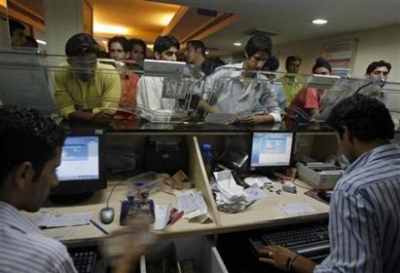
The spike at private sector lenders like ICICI Bank and Axis Bank follows a push to grab market share from India's dominant state banks.

SBI's Bhattacharya is ranked second on the list, while ICICI's Kochhar is 5th and Axis's Sharma is 19th in the Fortune list
Low-cost carrier Air Deccan and liquor baron Vijay Mallya-promoted Kingfisher Airlines have agreed not to "poach on one another's territory and instead help each other."

The activity taking place in the SME sector is phenomenal. I think we are seeing a new breed of entrepreneurs, says ICICI Bank CEO K V Kamath.

HDFC on Thursday offered home loans to women borrowers at 9.85 per cent.
Manufacturers have implemented learnings from the past, but there's still a worrying macro-micro disconnect.

Finance Minister Arun Jaitley said the magnitude of the alleged black money transfer through state-owned BoB will only be known after completion of the multi-disciplinary probe.

She said it is even more important in the changing dynamic world where the business environment also keeps on changing all the time.

The suspected security breach happened through a malware in the systems of Hitachi Payments Services, which serves ATM network of Yes Bank
Bankers and economists agree rates will soften, though the quantum would depend on banks' asset-liability profile

The S&P BSE Sensex and the Nifty50 have hit record highs amid the poll outcome-triggered bull frenzy at the bourses. Most analysts feel that the indices are on course to rise further over the next few months - till the general elections - albeit amid intermittent corrections - largely triggered by global developments. Bharatiya Janata Party's (BJP's) win in the three state elections of Madhya Pradesh (MP), Rajasthan and Chhattisgarh, analysts at Jefferies believe, reinforces the consensus expectations of a Modi win 2024 national elections with a greater likelihood of over 300 seats for the BJP.

In the first such collaboration for India, the country's flagship payments platform, the Unified Payments Interface (UPI), and Singapore's PayNow payment system have launched a real-time cross-border payment linkage system. The linkage, which was launched by Prime Minister (PM) Narendra Modi and Singapore's PM Lee Hsien Loong on Tuesday, was kicked off by a live cross-border transaction between Reserve Bank of India Governor Shaktikanta Das and Monetary Authority of Singapore managing director Ravi Menon, using mobile phones.

Banking operations including cheque clearance across the country got affected on Monday as bankers under the aegis of the United Forum of Bank Unions have gone on a nationwide strike to protest against the proposed privatisation of two state-owned lenders.
In a career spanning over 29 years, Sharma has had a wide exposure across the entire spectrum of financial services and has held several leadership positions across various market-leading businesses, the bank said in a statement. Axis Bank is the third-largest private sector bank in India and its network spans across more than 840 offices and over 3,600 ATMs.

In his statement to the Enforcement Directorate, Dhoot conceded that Rs 64 crore had been transferred to Deepak Kochhar's NuPower Renewables through a web of entities to allegedly acquire wind farm properties.

Puri gave up the comforts of Citibank to set up a new-age bank from a rat-infested room in the Kamala Mills Compound in Worli, Mumbai and build a marquee brand. A look at his 26-year stint as HDFC Bank's boss.

Global private equity (PE) firms are successfully offloading large equity stakes in domestic companies in the open market, taking advantage of buoyant conditions. Strong domestic liquidity support and an upward trending market have underpinned over a dozen PE exits worth $2.5 billion, data compiled by Business Standard shows. The figures exclude PE exits during maiden share sales and shares sold by strategic investors, such as SoftBank and Ant Group in new-age companies.

Banks are clear that lending rates are not going to fall further, say Hamsini Karthik and Anup Roy.

Apart from streamlining loan processing, most public sector banks charge lower interest rate, an aspect which seems to be game changer.

In a bid to gain a bigger share of the customer's wallet, banks are ramping up their cross-selling initiatives.

The index widened its loss towards the fag-end on emergence of intense selling in heavyweights like ITC, RIL and ICICI Bank. In percentage terms, however, Sun Pharma was the biggest loser with 9.39 per cent drop. Intra-day, the pharma major's shares tanked over 20 per cent.

Among Sensex components, shares of Reliance Industries, India's largest company by market value, stole the show by surging 1.61 per cent to their highest in over three months.

Home loans also pose lower bad-debt risks for the banks than corporate loans.

'India is an equity market with a breadth and depth of companies to invest in.'

The bank may post a loss of Rs 1,000 crore during October-December 2019-20 quarter, an analyst commented.

India Inc's net profit as a percentage of the country's gross domestic product (GDP) is just shy of reaching 5 per cent, bolstered by strong earnings growth in the second quarter of 2023-24. Analysts interpret this as an indication that a corporate profit upcycle is in progress, with projections suggesting that this share could exceed 8 per cent within the next five years, driven by bullish earnings growth expectations. "We believe we are only halfway through a profit cycle, with the profit share in GDP rising from a low of 2 per cent in 2020 to about 5 per cent currently, and likely heading to 8 per cent in the coming four to five years. "This implies about 20 per cent compounding of earnings growth. "Underscoring this forecast is the start of a new private capex cycle, under-geared balance sheets, a healthy banking system, lower corporate tax rates, improving terms of trade, and structural consumption demand outlook albeit somewhat offset by likely consolidation in government deficit," said Ridham Desai, managing director, head of research, Morgan Stanley India in a note.

SBI Chairperson Arundhati Bhattacharya said any rate cut by the bank would depend on a lot many factors.

The 57-year-old Bhattacharya, front-runner for the post on account of years of service left, was managing director and chief financial officer of the bank prior to her elevation.

In a memorable year for the equity market, Dalal Street investors added a whopping Rs 81.90 lakh crore to their wealth in 2023 as a raft of positive factors powered a stellar rally in stocks. Experts said India's strong macroeconomic fundamentals, political stability owing to the BJP's success in recent elections in three significant states, optimistic corporate earnings outlook, signals from the US Federal Reserve about three prospective rate cuts next year and heavy retail investors participation played a major role in fuelling the stock market rally in 2023. In the year 2023, the 30-share BSE Sensex jumped 11,399.52 points or 18.73 per cent.
Insolvency professionals feel the bankruptcy code will deter defaulters, but NPAs will not cease unless banks are sensitised on credit appraisal and experts are hired by banks to inspect what is happening with their loans.

The preference for digital banking now cuts across all customer segments.
Report holds Hitachi responsible for debit card data theft. When the data theft came to light, Hitachi had denied that its systems were compromised.
 © 2026 Rediff.com - Advertise with us - Disclaimer - Privacy Policy - Sitemap - Feedback - About us - Terms of use - Grievances